
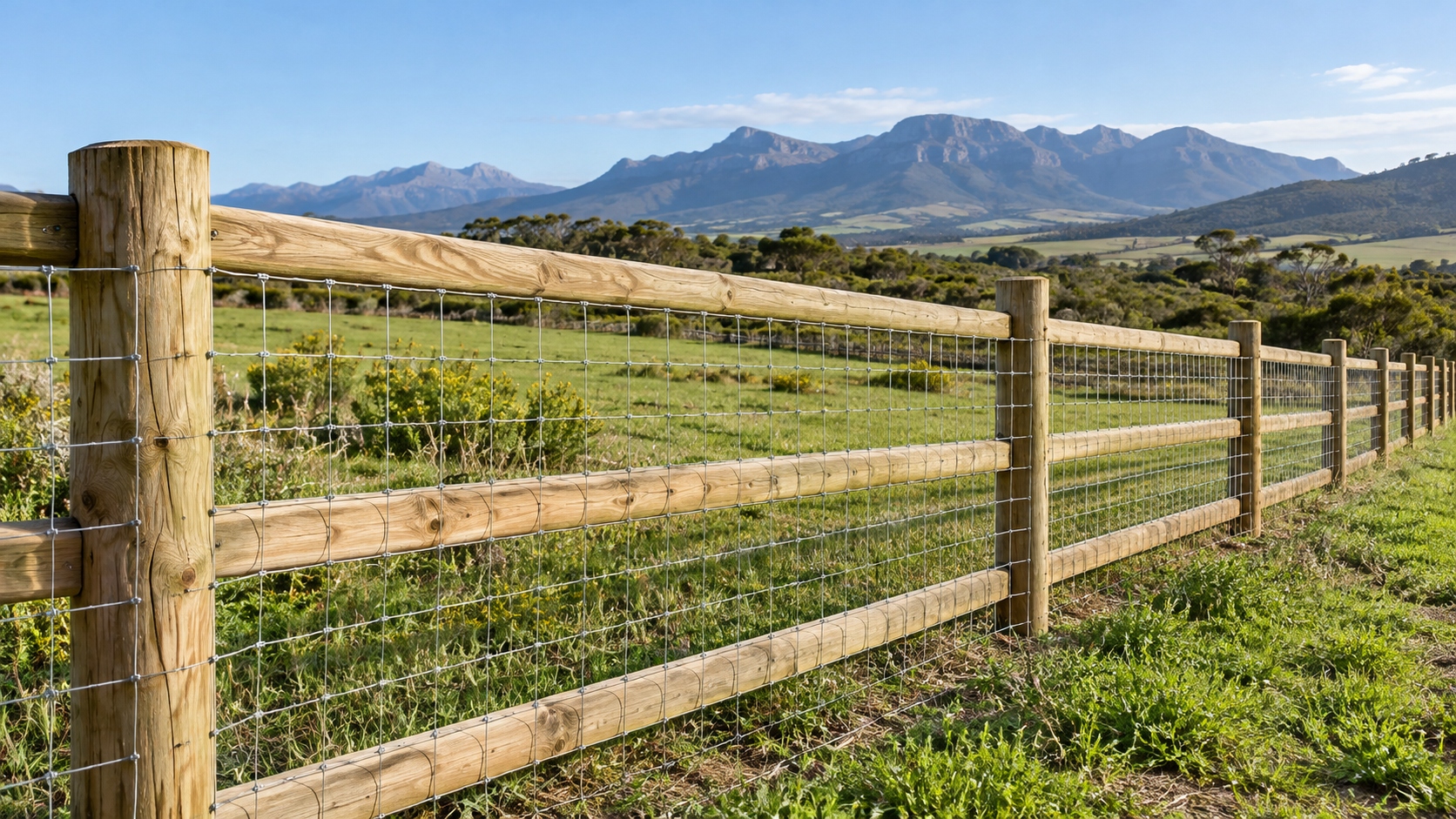
Ultimate Fencing installs and repairs farm and ranch fencing in Cape Town and surrounding areas. We help farms, smallholdings and rural properties establish practical boundaries, divide working land and choose fencing suited to the animals they keep.
Complete the form below and Ultimate Fencing will get back to you.
A fence around the edge of a property has a different job from one dividing grazing areas or enclosing a paddock. Before choosing the material, consider what the fence needs to keep in or out, how the land is used and where people and vehicles need to pass through.
On a working farm or vineyard, a boundary may run alongside access roads, cultivated land and neighbouring properties. On a smallholding, the same project may include an external boundary, a smaller animal enclosure and an entrance used throughout the day. Each part needs to work with the others.
We plan farm fencing around these practical requirements, whether the property is on Durbanville’s rural fringe, near Stellenbosch or in the smallholding and equestrian areas around Noordhoek. The aim is a fence that suits the land and its everyday use, with access where you need it.
Farm fencing is not one fixed product. The choice depends on whether you need a visible boundary, separation between parts of the property or containment for livestock. For animal enclosures, the height, openings and construction need to suit the animals’ size and behaviour, including any smaller or younger animals using the space.
Post-and-wire fencing uses wire strands or mesh supported by posts to form the fence line. It can suit longer farm boundaries and internal divisions, with the wire arrangement or mesh openings selected for the intended use. A fence marking the edge of cultivated land may need a different specification from one containing animals.
Timber or steel posts can be considered according to the site and construction. Corners, changes in direction and the ends of a run need suitable support because they carry the pull of the wire. Choosing only by the appearance or price of the mesh can overlook these parts of the installation.
Post-and-rail fencing creates an open, clearly visible boundary. It can suit rural entrances, paddock divisions and areas where you want to retain views across the property. The rails give the fence its familiar ranch appearance, but the spaces between them are an important part of the decision.
Open rails alone will not contain every type of animal. Where smaller animals could pass through, an appropriate infill may be needed. The rail arrangement, gaps and any infill should be considered together for the enclosure’s intended use.
If preventing intrusion is a main concern, discuss that alongside the agricultural requirements. Electric fencing or Clearview security fencing may be appropriate for parts of the property that need a different level of perimeter protection.
Complete the form below and Ultimate Fencing will get back to you.
A workable fence line needs to follow the property’s layout without creating unnecessary obstacles. We consider the route, changes in ground level, corners and access points together, so the fencing and gates form one usable boundary.
Uneven ground can leave openings beneath a fence or require changes in how sections are installed. Vegetation may need clearing along the proposed route, while drainage paths need attention so that the work does not obstruct the movement of water. Existing posts, old wire and damaged sections also affect how a replacement line can be approached.
Gate positions deserve attention before installation starts. An entrance used by a car may not provide enough room for a tractor, trailer or other farm equipment. The opening, supporting posts and space for the gate to move all need to suit the vehicles using it. Consider how vehicles turn towards the entrance as well as how they pass through it.
Internal gates should make it practical to move between paddocks or working areas without repeatedly opening the main entrance. We can include gate installation and repairs in the fencing work, including attention to existing gates that no longer close properly against the fence line.
A damaged section does not always mean the whole fence needs replacing. Where the surrounding fence is still sound, repairs may involve replacing posts or rails, repairing wire sections or restoring connections between the fence and its supports.
The cause of the damage matters. A loose post can affect the sections on either side, while a leaning end or corner can leave a longer wire run slack. Reattaching wire without addressing a failed support may leave the same problem in place. We look at the affected section and the adjoining fence when considering the repair.
Gates and low points along the fence also need checking. Gaps beneath the line, a damaged latch or a gate that no longer meets its closing post can undermine an otherwise serviceable enclosure. Corrosion in steel components and deterioration in timber help determine which parts can reasonably be retained.
Where damage or deterioration extends across much of the line, replacement may be more practical than repeated repairs. We can discuss repairing individual sections or renewing the affected run. For properties with several fencing materials, our fence repairs and maintenance service can address the wider work required.
The length of the fence is only one part of the price. Height, wire or rail construction, post requirements and the number of corners all affect the materials and work involved. Gates add their own requirements for openings, supports and hardware.
Site conditions also matter. A clear, accessible fence line is different from a route with dense vegetation, difficult ground or old fencing to remove. On a repair project, the condition of existing posts and adjoining sections determines how much can be reused.
When comparing quotations, check that they cover the same fence construction, gate requirements, removal work and installation scope. A lower total may reflect a different specification or work that has been left out.
To request a quote, tell us where the property is, what the fence needs to do and whether you need a new installation or repairs. An approximate length and a description of the existing fence are useful starting points if you have them.
Complete the form below and Ultimate Fencing will get back to you.
We provide farm and ranch fencing in Cape Town and surrounding areas, including but not limited to Durbanville and the northern rural fringe, Philadelphia, Stellenbosch and Noordhoek. Projects can include external boundaries, internal divisions, paddocks and repairs to existing farm fences.
Whether you are fencing an open stretch of land or improving a smaller enclosure, the starting point is the property’s use and the work needed. Tell us your location and what you would like to achieve, and we can discuss a suitable approach to the fencing and access points.
